

Photoaging Explained: How to Stimulate Collagen Production & Repair Sun-Damaged Skin
Written by: The Sparkle Wellness Team
Reviewed by: Dr. Ilma Imtiaz
Photoaging is more than a surface-level concern; it is a fundamental shift in your skin’s structural integrity. Cumulative UV exposure does not simply create visible changes; it penetrates deep into the skin, impacting firmness and causing cellular DNA damage. While it is common to view sun-driven shifts as inevitable markers of time, board-certified dermatologist Dr. Maren Locke emphasizes that these structural changes are highly responsive to targeted intervention.
By understanding the science of well-aging, we can move beyond reactive damage control toward a proactive strategy of reinforcing and optimizing your skin’s natural resilience. Here is how you can utilize bioactive support to restore the architecture of your skin.
What Is Photoaging?
Photoaging is the term dermatologists use for skin aging caused by cumulative exposure to ultraviolet (UV) light, as opposed to the natural aging process that happens with time alone. Where chronological aging is slow and largely genetic, photoaging is driven almost entirely by sun exposure, and it's responsible for many of the visible changes we associate with "aging" skin: fine lines, deep wrinkles, loss of firmness, sagging, uneven pigmentation and a rough or leathery texture.
The distinction matters because photoaging is, at least to an extent, preventable and treatable. Unlike the aging clock built into your DNA, the damage caused by UV exposure results from a specific, well-understood biological process that occurs well below the surface of your skin.
How UV Damage Breaks Down Your Skin's Collagen and Elastin
To understand why photoaging shows up the way it does, it helps to understand what's holding your skin up in the first place: collagen and elastin. These structural proteins form the scaffolding of your dermis — the layer beneath the surface that gives skin its firmness, bounce and ability to snap back into place.
"UV rays actually penetrate into your skin where they create free radicals that damage your collagen and elastin that are holding your skin up and taut," explains Dr. Locke. "This leads to accelerated signs of aging like wrinkles and sagging skin."
That free radical damage is cumulative. Every unprotected sun exposure — not just sunburns — contributes to the slow breakdown of this scaffolding. Over years, collagen fibers fragment and disorganize, and elastin loses its ability to spring back, which is why photoaged skin doesn't just look older, it behaves differently, wrinkling and sagging in ways that chronologically aged, sun-protected skin doesn't.
Collagen Breakdown and Renewal: Why SPF Is Only Part of the Picture
Photoaging creates an imbalance beneath the surface of your skin. Repeated UV exposure switches on enzymes that break down collagen while also disrupting the signals involved in making new collagen [1,2]. Over time, skin begins to lose this structural protein faster than it can replace it, contributing to wrinkles, sagging and reduced firmness.
This is the part many sun-care conversations leave out. Daily broad-spectrum SPF is essential because it helps limit further UV damage, but it is not designed to replace collagen that has already been lost.
That is why a more complete well-aging strategy has two parts: protect your skin from future UV exposure and support its normal collagen-production processes. Research suggests that certain specific bioactive collagen peptides may support collagen production and improve measures such as wrinkle appearance and skin elasticity [3,4].
How to Stimulate Collagen Production in Skin: What the Research Shows
So how do you actually boost collagen production once the damage is done? The evidence points in two directions: protecting what you have, and actively feeding the process that rebuilds it.
On the prevention side, daily broad-spectrum SPF, antioxidant serums and topical retinoids all have solid research behind them for slowing further collagen breakdown. But a growing body of clinical research has also looked at supporting collagen production from the inside out, through targeted oral collagen peptide supplementation, and the results are notable.
In one double-blind, placebo-controlled trial of 114 women aged 45–65, participants who took 2.5 grams daily of a specific bioactive collagen peptide (VERISOL) for 8 weeks saw a statistically significant 20% reduction in eye wrinkle volume compared to placebo, along with a 65% increase in procollagen type I and an 18% increase in elastin [3].
A related study of 69 women aged 35–55 found statistically significant improvements in skin elasticity after 8 weeks of daily collagen peptide supplementation, with benefits still measurable a month after stopping (Proksch et al., Skin Pharmacology and Physiology, 27(1):47–55).
"That’s why I like to support this collagen production from the inside out by taking a collagen supplement," says Dr. Locke.
How to Boost Collagen Production the Right Way: Why the Peptide You Choose Matters
Here's where it gets more specific, because "collagen supplement" is not a one-size-fits-all category. Collagen is a large molecule, and generic collagen powders vary widely in how well they're broken down and absorbed.
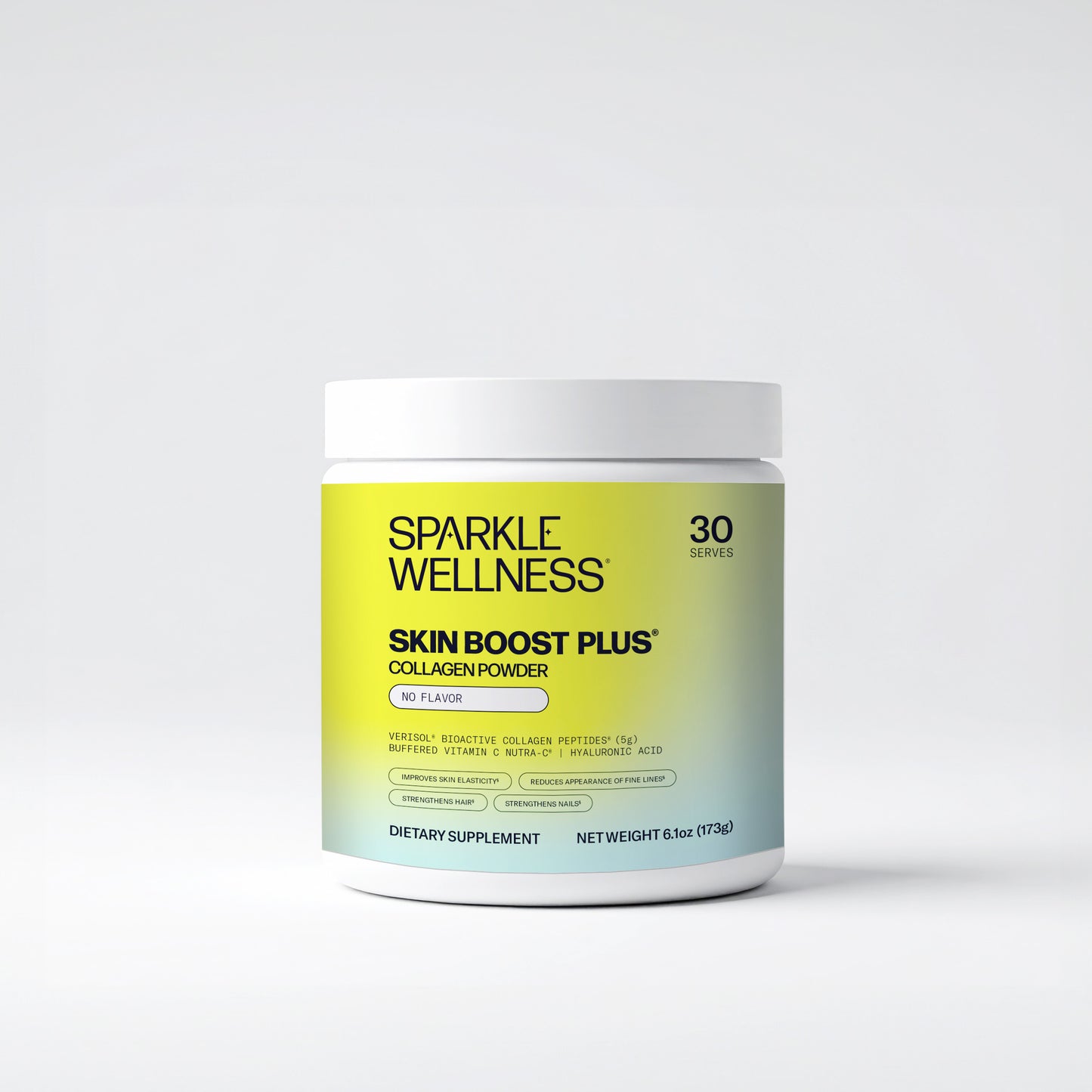
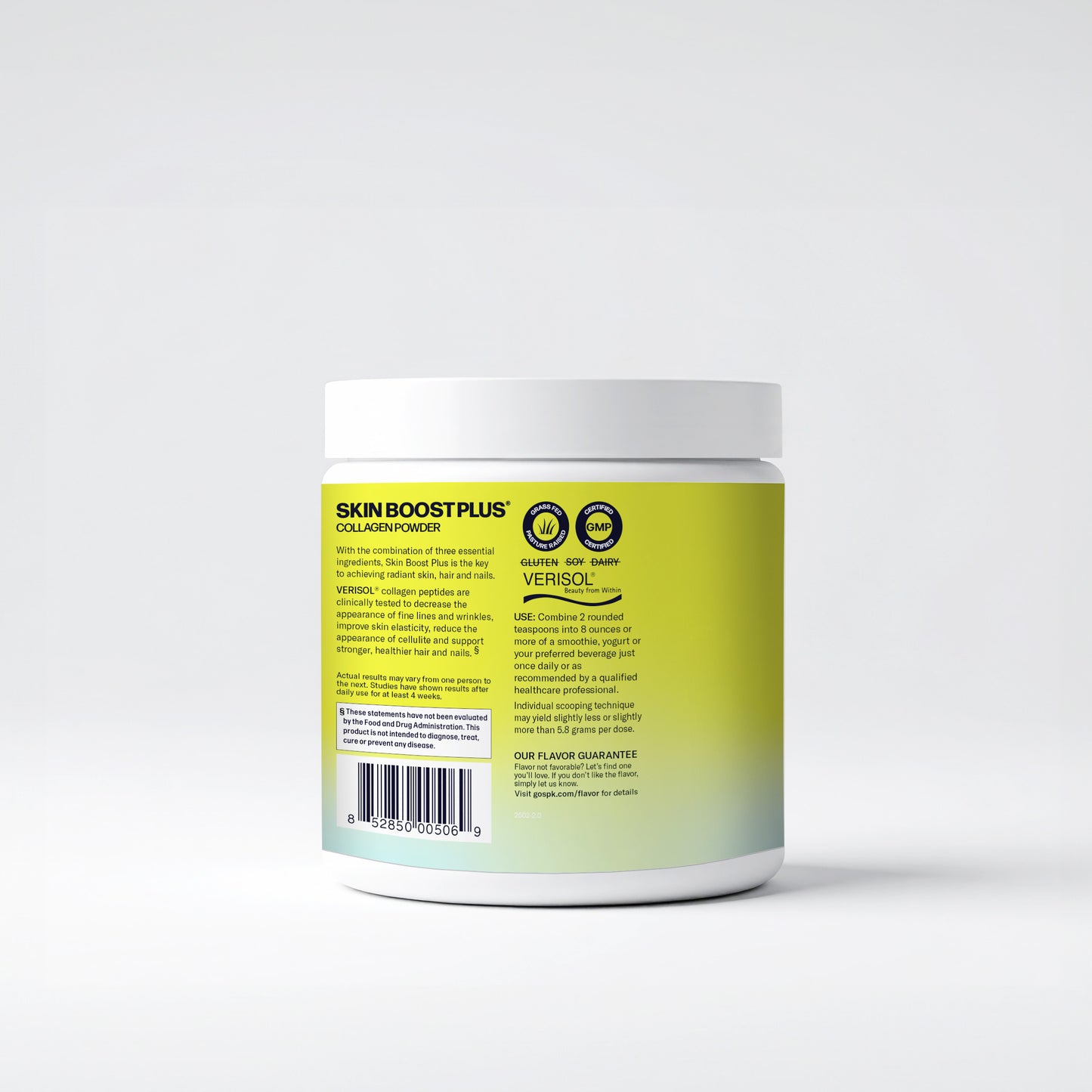
"I specifically use Skin Boost Plus because it contains VERISOL collagen peptides," Dr. Locke explains. "These are different than generic collagen. After you digest these, the peptide fragments are absorbed into your bloodstream and can signal your skin to make new collagen and fight back against these deeper signs of aging."
VERISOL is a specific bioactive collagen peptide studied in multiple randomized, placebo-controlled trials, including a 6-month study of 105 women that found significant improvements in dermal density and skin texture, while the placebo group's dermal density actually declined over the same period [5].
This is where the questions, "How to increase skin collagen?" and "Which ingredients stimulate collagen production?" lead to the same answer: it's not just about consuming more collagen; it's about consuming collagen peptides small enough and designed to target your skin cells and signal their fibroblasts to get back to work.
THE BOTTOM LINE: BEYOND DEFENSE
Photoaging is a cumulative structural shift, but it is not a permanent one. While surface-level treatments offer temporary fixes, true skin resilience requires supporting the dermal matrix from within. Dr. Locke reminds us: "I think of it as supporting the foundation of your skin, not just treating the surface."
Daily sun protection remains your non-negotiable first line of defense. However, stopping at SPF means you are only playing defense. To truly optimize your skin’s architecture, you must pair protection with precision. By incorporating clinically studied bioactive collagen peptides, like the VERISOL found in Sparkle Wellness Skin Boost Plus, you provide your fibroblasts with the exact signals needed to synthesize new collagen and elastin, actively reversing the structural impact of UV exposure. Don't just protect your skin; empower it to repair.

Dr. Maren Locke is a board-certified dermatologist with expertise in all things hair, skin and nails, and a fellowship-trained Mohs surgeon. She is also the founder of Carlyle Dermatology, where she offers comprehensive dermatologic care.

Dr. Ilma Imtiaz has a background in biomedical and naturopathic research and recently completed her PhD at the National Centre for Naturopathic Medicine, Southern Cross University, Australia. She is a lead and co-author of multiple peer-reviewed publications, including experimental and review papers across herbal medicine, cancer biology and molecular mechanisms.
At the heart of her work is a passion for science communication, translating complex evidence into clear, engaging, and accessible insights. She is committed to evidence-led wellness and supporting informed, balanced health decisions.
REFERENCES
1. Fisher GJ, Wang ZQ, Datta SC, Varani J, Kang S, Voorhees JJ. Pathophysiology of premature skin aging induced by ultraviolet light. N Engl J Med. 1997;337(20):1419-1428.
2. Rittié L, Fisher GJ. UV-light-induced signal cascades and skin aging. Ageing Res Rev. 2002;1(4):705-720.
3. Proksch E, Segger D, Degwert J, Schunck M, Zague V, Oesser S. Oral Intake of Specific Bioactive Collagen Peptides Reduces Skin Wrinkles and Increases Dermal Matrix Synthesis. Skin Pharmacol Physiol. 2014;27(3):113-119.
4. Proksch E, Schunck M, Zague V, Segger D, Degwert J, Oesser S. Oral Supplementation of Specific Collagen Peptides Has Beneficial Effects on Human Skin Physiology: A Double-Blind, Placebo-Controlled Study. Skin Pharmacol Physiol. 2014;27(1):47-55.
5. Schunck M, Zague V, Oesser S, Proksch E. Dietary Supplementation with Specific Collagen Peptides Has a Body Mass Index–Dependent Beneficial Effect on Cellulite Morphology. J Med Food. 2015;18(12):1340-1348.